 EN
 GA
 DE
 ES
 FR
 IT
 PL
 PT


Contents
Strategy 2: Replacing the current state MFL examinations (Junior Cycle and Leaving Certificate) with CEFR international examinations.
The second proposed strategy to realise the plurilingual vision of the Barcelona Summit Agreement is that of replacing the current post-primary modern foreign language (MFL) state examinations with Common European Framework of Reference for Languages (CEFR) international examinations.
As students would already be set in line with their CEFR level (strategy 1), this would serve as a complementary strategy certifying level by level that students are realising the plurilingual vision of the Barcelona Summit Agreement (mother tongue plus two additional languages). In essence, strategy 1 would prepare students for their CEFR level, while strategy 2 would assess students to determine the extent to which they have achieved the standard for that level.
By undertaking official CEFR exams, students would be afforded the opportunity during their time at second-level education to be awarded internationally recognised MFL qualifications that are valid for life – one in place of the Junior Cycle MFL exams and the other in lieu of the Leaving Certificate MFL exams.
How second-level students are currently assessed in Ireland
Second-level students in Ireland undertake two state examinations: the Junior Cycle at the end of Third Year (students are around 15 years old), and the Leaving Certificate at the end of Sixth Year (final year at second level, students are around 17 to 18 years old).
The key issue with the current state MFL exams
The fundamental flaw with both the Junior Cycle and Leaving Certificate MFL examinations is that the actual standard of the exams is not transparent. Neither state exam is properly aligned to any internationally recognised calibrating instrument for additional languages.
Consequently, what student grades actually represent remains ambiguous. What does a H4 or an O2 grade actually tell us about a student’s MFL standard? Furthermore, these official grades give only a single final result as opposed to a breakdown of performance across each language skill. For example, a student may be very good at reading and writing but may have poor oral skills.
How the proposed examination model would work in practice
As detailed in strategy 1, given MFL students receive a minimum of 380 hours of MFL tuition over the course of their second-level studies, should they commence their MFL studies with little or no prior knowledge of their MFL, they should be in a position to successfully complete CEFR levels A1, A2, and B1 by the time they finish their post-primary education.
Students would do two types of examinations: 1) sublevel examinations (e.g., A1.1, A1.2, A2.1, A2.2), and 2) official CEFR whole-level examinations when they complete each full CEFR level (e.g., A1, A2, B1).
Table 4.1 illustrates how students could realistically progress to CEFR B1 level by the end of Sixth Year should they commence their MFL studies at A1.1 level at the start of First Year and pass each subsequent sublevel of the various CEFR levels throughout their second-level education.
If students pass sublevels A1.1 and A1.2 in First Year, by December of Second Year, they should be in a position to sit their first CEFR whole-level examination (A1 level). Should students pass the A1 examination and successfully progress through sublevels A2.1 and A2.2, they would then sit the CEFR A2 examination in place of the Junior Cycle MFL examinations at the end of Third Year. Should students be successful in their official CEFR A2 examination, they would do sublevels B1.1 to B1.4 in Fifth Year and Sixth Year and take the CEFR B1 examination at the end of Sixth Year in place of their Leaving Certificate MFL examinations. Under the proposed schedule, students would undertake three sublevels at A1 level, three sublevels at A2 level, and four sublevels at B1 level. Should students do Transition Year (generally an optional fourth year), they would have extra exposure to their MFL, and as such, they may wish to work towards achieving a low B2 CEFR level or higher by the end of Sixth Year.
| Year | Term | Level | Type of exam |
|---|---|---|---|
| 1st year | Term 1 | A1.1 | sublevel |
| 1st year | Terms 2 & 3 | A1.2 | sublevel |
| 2nd year | Term 1 | A1.3 | CEFR A1 exam |
| 2nd year | Terms 2 & 3 | A2.1 | sublevel |
| 3rd year | Term 1 | A2.2 | sublevel |
| 3rd year | Terms 2 & 3 | A2.3 | CEFR A2 exam |
| Transition Year | Term 1 | Optional year | sublevel |
| Transition Year | Terms 2 & 3 | Optional year | sublevel |
| 5th year | Term 1 | B1.1 | sublevel |
| 5th year | Terms 2 & 3 | B1.2 | sublevel |
| 6th year | Term 1 | B1.3 | sublevel |
| 6th year | Terms 2 & 3 | B1.4 | CEFR B1 exam |
As detailed in Table 4.1, the examination calendar would be aligned in large part to the existing division of the academic school year at second level in Ireland (end of August to end of May). Term 1 is the longest term from late August to the Christmas holidays / winter break (December). Terms 2 and 3 combined (January to May) are usually just a few weeks longer than term 1.
With the proposed examination model, twice a year, students would have the opportunity to sit exams in order to progress from one sublevel to the next (e.g., A2.1 to A2.2). The proposed examination model would mean that students would likely be in one MFL sublevel from September to December (e.g., A2.1), and if they pass that sublevel, they would progress to the next sublevel from January to May (e.g., A2.2), and so on. Depending on the extent to which a student fails their sublevel exam, they may have to repeat the sublevel course.
The sublevel CEFR exams would ultimately prepare students for their official whole-level CEFR exams. Under the proposed schedule of exams, as outlined in the table above, if students commence at A1.1 sublevel at the start of First Year, they would be expected to sit three official whole-level CEFR exams: A1 in December of Second Year, A2 in place of the Junior Cycle MFL examinations in June of Third Year, and B1 in lieu of the Leaving Certificate MFL examinations in June of Sixth Year. The proposed examination model would allow students to take exams at a different level, e.g., a second-year student could sit an A2 level exam instead of A1, and a sixth-year student could do a B2 level exam instead of B1.
CEFR examination bodies
The official CEFR exams that the Irish education system could use for assessing its curricular MFLs are delineated in Table 4.2 (other certification bodies may also be available). All the exams listed in the table have been specifically developed in alignment with the CEFR 2001 and its descriptor scales. French, German, Italian, and Spanish are currently the only curricular MFLs that schools can offer their students throughout all post-primary school years. Other MFLs are offered; however, at present, not on a curricular level throughout all school years. The examination services of the official CEFR accreditation bodies for those other languages could also be employed.
| French | France Éducation International offers examinations for non-native speakers of French in line with the CEFR. The Diplôme d'études en langue française (DELF) assesses four exam levels – A1, A2, B1 and B2. For learners wishing to sit exams at C1 and C2 levels, they can take the Diplôme approfondi de langue française (DALF). French as an additional language exams specifically created for teenagers are available, e.g., DELF Junior / Scolaire.* |
| German | Goethe-Institut provides different types of examinations for non-native speakers of the German language. The Goethe-Zertifikat exams are available for all levels: A1 to C2. German as an additional language exams specifically created for teenagers are available, e.g., Goethe-Zertifikat exams for young learners.* |
| Italian | Università per Stranieri di Perugia offers examinations for non-native speakers of Italian in line with the CEFR. The Certificato di Conoscenza della Lingua Italiana (CELI) is an internationally recognised qualification for all six CEFR language levels in Italian from A1 to C2. Italian as an additional language exams specifically created for teenagers are available, e.g., CELI a (adolescenti).* |
| Spanish | Instituto Cervantes provides examinations for non-native speakers of Spanish in line with the CEFR. The Diplomas de Español como Lengua Extranjera (DELE) assess all levels from A1 to C2. Spanish as an additional language exams specifically created for teenagers are available, e.g., exámenes DELE para escolares.* |
* Generally, CEFR exams for young learners are available at levels A1 to B2. Different criteria apply as to what constitutes a young learner; for some languages, if the candidate is 18 years of age or older, they are required to take the standard adult CEFR exam.
Presenting and interpreting student CEFR whole-level exam results
While some students would achieve the same CEFR level in all four skills (reading, writing, listening, and speaking), for many others, this will not be the case; they will be stronger and weaker in certain competences. In terms of presenting each student’s CEFR exam results, it is important that they are illustrated visually followed by a transcript of results detailing the breakdown of performance across each language skill.
Figure 4.1 illustrates how a student’s CEFR grade could be presented visually across all four language skills. In this case, the student takes the B1 exam. Their results indicate that their reading is a low B2 level, their writing and listening are a high B1 level, and their speaking is a high A2 level.
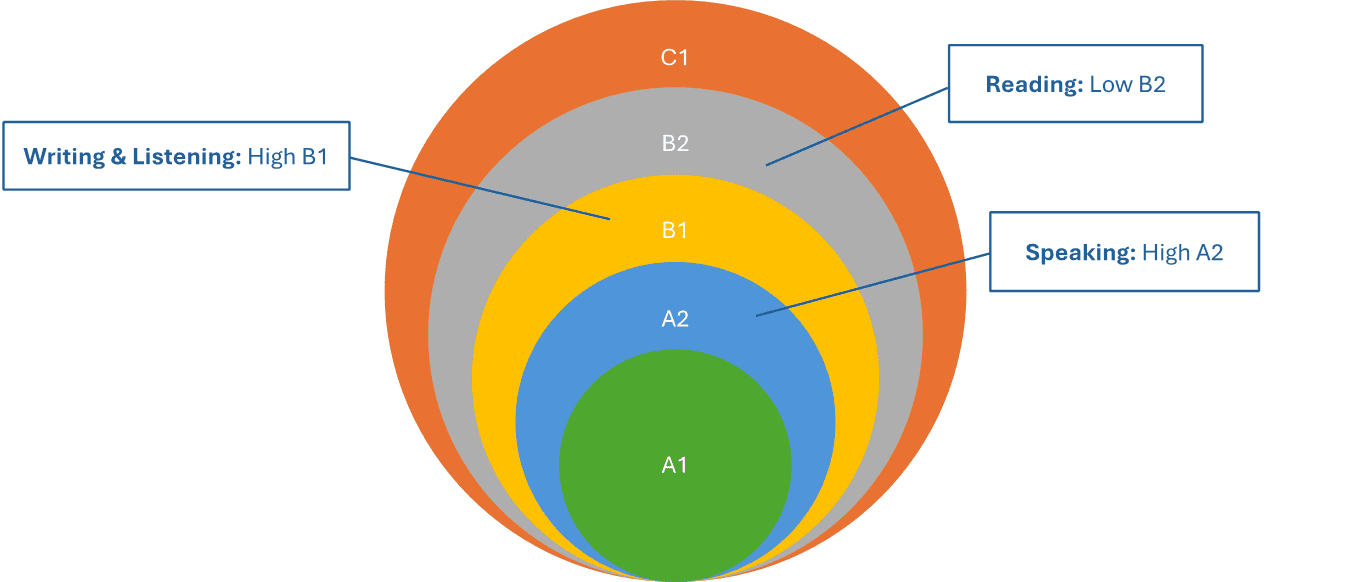
Figure 4.1: Sample visual breakdown of student CEFR results
Matriculation implications
In order to undertake a course at a third-level institution in Ireland (e.g., universities), students need to satisfy the matriculation requirements for the course they wish to pursue. In essence, each third-level course is generally set a minimum number of points. The higher the points for a course, the more the course is in demand. The students’ Leaving Certificate results are converted into points. If a student has enough points and has fulfilled all other criteria, they will be offered a place on the course.
In order to calculate one’s points, each student’s six best Leaving Certificate subject results are converted into points. Table 4.3 details how points are allocated based on student performance in each subject: H1 – H8 (Higher level) and O1 – O8 (Ordinary level) (Irish Universities Association and Institutes of Technology, 2015). In general, in the Leaving Certificate examinations, 100 points is the maximum number of points students can obtain per subject at Higher level and 56 points is the maximum number of points they can be awarded per subject at Ordinary level. By way of an example, a student sits the French Higher level Leaving Certificate exam and obtains an overall grade of 62%. Given this result, the student is awarded a H4 grade, and this is converted to 66 points for matriculation purposes.
| Per cent in Leaving Certificate Examinations | Leaving Certificate Grading Scale | Points at Higher Level | Points at Ordinary Level |
|---|---|---|---|
| 90 – 100 | H1 / O1 | 100 | 56 |
| 80 – 89 | H2 / O2 | 88 | 46 |
| 70 – 79 | H3 / O3 | 77 | 37 |
| 60 – 69 | H4 / O4 | 66 | 28 |
| 50 – 59 | H5 / O5 | 56 | 20 |
| 40 – 49 | H6 / O6 | 46 | 12 |
| 30 – 39 | H7 / O7 | 37 | 0 |
| 0 – 30 | H7 / O7 | 0 | 0 |
In terms of how the proposed CEFR examination system would work for matriculation purposes for the Leaving Certificate examinations, the following model is presented. As discussed, if students receive a minimum of 380 hours of MFL tuition over the course of their second-level studies, the expected CEFR standard for students to achieve is that of B1 level by the end of Sixth Year. Given that 1) a B1 standard is the CEFR level students are expected to achieve, and 2) 60% is generally considered the pass grade in the CEFR examinations, if students meet these two criteria, they should be awarded the equivalent of a H1 grade in the Leaving Certificate MFL Higher level examinations (90% to 100%) and receive 100 points.
Providing students with just the option of pass or fail in their CEFR whole-level exams (i.e., a score of 60% or above constitutes a pass, while below 60% is a fail) would be too restrictive. The Cambridge English Qualifications, which assess the English language competences of non-native English speakers, offer a flexible examination and certification model with components worthy of adoption. With their examination model, if a candidate does not pass their CEFR exam, their achievement at the CEFR level below can still be recognised. Similarly, if the candidate excels at the current CEFR exam level, this accomplishment is also acknowledged. For example, its CEFR B1 English as an Additional Language examination, specifically designed for primary and post-primary students, entitled B1 Preliminary for Schools, notes that while the exam is designed for the B1 level, the exam offers a reliable evaluation at the next level (B2) as well as at the level before (A2) (Cambridge English Language Assessment, 2024b). As a result, if a candidate achieves a grade within a certain range, they are awarded the B1 certificate. However, if they excel in the exam (exceeding a specific mark), they receive a certificate stating that they have demonstrated ability at B2 level. Similarly, if they do not meet the standard for B1 level, but obtain a mark within a given lower range, the candidate receives a certificate stating that they have demonstrated ability at A2 level.
The proposed CEFR whole-level examination model presented in this chapter would offer even greater flexibility than the Cambridge English Qualifications. While 60% is generally the pass mark for official CEFR examinations, the following grading scale would be facilitated:
- candidates who achieve between 60% and 79% would be awarded a ‘high’ CEFR grade;
- candidates who obtain between 40% and 59% would be awarded a ‘low’ CEFR grade;
- candidates who receive a result of 80% or higher would be awarded a ‘low’ CEFR grade for the following CEFR level.
By way of an example, if a student gets between 40% and 59% in their B1 official CEFR exams, they would be awarded ‘low B1’ standard, if they get between 60% and 79%, they would be awarded a ‘high B1’ standard, and if they obtain 80% or higher in their B1 exam, they would be awarded a ‘low B2’ level. Given that the pass grade for CEFR exams is generally 60%, the proposed flexibility of awarding standards (e.g., low B1) would likely require the agreement of the international CEFR examination bodies.
Readers will note the use of ‘low’ and ‘high’ before CEFR examinations grades. As CEFR levels (e.g., B1) can be subdivided into several sublevels (e.g., B1.1, B1.2, B1.3, and B1.4), it would be most confusing to award student certificates based on this sublevel format. For example, what does a B1.1 certificate actually mean? In the proposed examination model, the B1 level is divided into four sublevels, but in another country, B1 could be divided into three or five sublevels, and so on.
For those students who excel at B1 level and demonstrate ability at a low B2 standard, rewarding extra points would be justified. Such provision for extra points (beyond that of 100 points) already exists in the case of the Leaving Certificate Mathematics exam in the Irish education system. Students who obtain 40% or higher in their Leaving Certificate Mathematics Higher level paper are awarded an additional 25 points. In the case of MFLs, it is proposed that a bonus of 25 points be awarded to candidates who achieve a low B2 level or higher. These additional points would act as a true incentive for students to achieve a minimum level of low B2, which is at the higher end of independent user category in the CEFR.
An important distinction needs to be made between a) a student meeting specific criteria to be awarded an official CEFR certificate, and b) the overall percentage result a student achieves in their CEFR exams. For example, a student may achieve an overall grade of 65% in their B1 CEFR exam, but not meet the criteria to be awarded a B1 certificate (e.g., they did not pass the mandatory oral part of the exam). Regardless of the CEFR criteria, for matriculation purposes, the overall grade across all four competences (in this case 65%) is what should be used. In this example, if the student wishes to be awarded the actual B1 CEFR certificate, they would need to resit the oral exam within a given period of time (determined by the CEFR examination body). This resit of part of the CEFR exam would only permit the student to obtain their CEFR certificate; it could not be used for extra matriculation points.
In the proposed examination model for schools, students could take an exam at any CEFR level between A1 and C2. While a student can be awarded a higher CEFR certificate (e.g., C1), the matriculation points would be capped at 125 (low B2). The minimum CEFR level would be A1. Levels A2 and B1 should allow for an increase or decrease in points depending on the extent to which the student excels or fails the respective CEFR level. Table 4.4 presents the proposed matriculation points for the official CEFR exams based on students’ highest CEFR exam level and grade at second level.
| CEFR | Points |
|---|---|
| A1 | 20 |
| Low A2 | 35 |
| High A2 | 55 |
| Low B1 | 75 |
| High B1 | 100 |
| Low B2 | 125 |
In order to understand the proposal in practice, some examples are offered. As illustrated in Table 4.5, student A sits the B1 exams and obtains 65%. This student has passed the level and is awarded a high B1 certificate and gets 100 points for matriculation purposes (as part of the Leaving Certificate examinations). Student B also sits the B1 exam but obtains 47%. As this grade is between 40% and 59%, this student is awarded a low B1 certificate and gets 75 points in the Leaving Certificate. Student C does the same B1 exam and obtains 82% in the exam. This student has not sat the B2 level exam but demonstrates ability at the next CEFR level. As such, a low B2 grade is awarded and the student gets 125 points in the Leaving Certificate.
| Student A | Student B | Student C | |
|---|---|---|---|
| CEFR exam level taken | B1 | B1 | B1 |
| Exam Grade | 65% | 47% | 82% |
| Grading Bracket | (60% - 79%) | (40% - 59%) | (81% - 100%) |
| CEFR level awarded | High B1 | Low B1 | Low B2 |
| Leaving Certificate Points | 100 | 75 | 125 |
It could be argued that some matriculation points should be awarded to students who achieve between 30% and 39%. However, it should be quite clear that if students achieve more than 20% less than the official pass grade (i.e., generally 60%), they are clearly taking the exam at the incorrect CEFR level. The whole basis for the CEFR model as outlined in this book is that students are grouped in line with their actual CEFR level.
Benefits of the strategy
Replacing the current state MFL exams (Junior Cycle and Leaving Certificate) with Common European Framework of Reference for Languages (CEFR) international exams would be a significant departure from how MFLs have traditionally been examined in the second-level education system in Ireland. The proposed examination model would offer numerous advantages. Evidently, some of the benefits overlap with those for strategy 1.
- It offers transparency of standard; each student would clearly know their MFL level.
- If successful in their official CEFR exams, students would be awarded an internationally recognised CEFR certificate that would be valid for life. This CEFR document would act as an international language passport of sorts.
- By students being required to do oral exams as part of both the CEFR sublevel exams and whole-level exams, this should have a positive impact on the teaching and learning environment where speaking the MFL would likely be prioritised more from the very early stages of students’ second-level studies. This in turn should improve students’ oral proficiency in their MFL.
- In the present structures, students can remain in the same MFL class year in and year out and perform poorly. This system would highlight to stakeholders very clearly sublevel-by-sublevel when students are not meeting the expected targets.
- It would support lifelong MFL learning. When students complete their second-level education, they would know their CEFR level. They could then continue to the next level by way of an online course, a part-time in-person course, a third-level course, and so on. In the case where some time (e.g. some years) passes and the learner wishes to recommence their MFL studies, they would know the previous CEFR level they completed and could do a refresher course at that level.
- For students wishing to continue their MFL as part of their third-level studies (e.g. universities), such institutions would know the exact CEFR levels of the students.
- Given that the proposed CEFR exams are internationally recognised, from a mobility perspective, it would likely make it easier for students to live and work in countries where the MFL is the national and/or official language.
- Some students could have greater third-level opportunities in countries where their MFL is the national and/or official language. Such countries generally require prospective students who are non-native speakers of the language and who wish to study at one of their third-level institutions (e.g., universities) to have a minimum CEFR level of B2.
- Students would be able to undertake their CEFR exams earlier than at the end of Sixth Year (usual period of the Leaving Certificate examinations). They could even sit their highest CEFR level in Fifth Year (e.g., B1). In this scenario, they could then spend Sixth Year focusing on another MFL for pleasure (even at ab initio level) or spend the year studying for their other Leaving Certificate examinations.
- By students being able to take their CEFR exams earlier than at the end of Sixth Year, this would likely reduce the amount of stress students experience in the lead-up to and during the Leaving Certificate examination period.
- From an employer’s perspective, the proposed examination model would make it easier for them to determine the MFL standards of their current employees as well as prospective employees.
- The proposed model allows for recognition of students’ CEFR levels even when they fail by a given percentage. It also awards students a higher CEFR level if they excel by a certain margin. For example, a student sitting the B1 examinations fails by a few per cent will be awarded a ‘low B1’ certificate. Likewise, if a student takes the B1 examinations and excels (obtains a grade of 80% or higher), they would be awarded a ‘low B2’ certificate.
- Extra matriculation points (i.e., 25) would be awarded for students who achieve a low B2 level or higher.
- The harmonisation of classes in line with the Common European Framework of Reference for Languages through cross-age teaching (strategy 1) and corresponding CEFR examinations (strategy 2) would complement each other and be an example of gamification of learning in action (discussed in Chapter Three). Just like a game, students would be working towards achieving their next sublevel (e.g., A1.1, A1.2, A2.1) or whole level (e.g., A1, A2, B1). The strategy would reward students as they progress. Upon successfully completing each sublevel and whole level, they would be awarded a certificate. The most significant award at second level would be students’ final internationally recognised CEFR qualification certifying their highest level of competence in their MFL. Such gamification of learning has the potential to boost student motivation in their additional language learning and greatly increase the numbers of plurilingual second-level students.
This is a preprint of the following work: Edward P. Flynn, Cross-age Teaching and Plurilingualism: Realising the Barcelona Summit Agreement, 2026, Palgrave Macmillan, reproduced with permission of Springer Nature. The final authenticated version is available online at: https://doi.org/10.1007/978-3-031-96656-9.